
Jesus: The Videos

My co-author for the book The Color of Christ, Edward J. Blum, has over the summer had a team of students working on a website to accompany our book, and it’s just about there, so we hope you’ll check it out. The website includes a huge array of supporting and supplementary material to go along with the book — links and images to texts, painting, movies, other books, etc., as well as suggested powerpoint templates, classroom syllabi and assignments, and much other material for teachers and professors. We are also collecting youtube style videos made by a variety of folks both about their own responses to Jesus images in their lives as well as responses to a series of paintings by Janet McKenzie, “Stations of the Cross.” Go here to watch a few of those videos, and more will be posted in the next month or two.

Posted in Uncategorized | Leave a comment

The Jesus Collector

This is from my friend John Fea, historian at Messiah College and author of the excellent book Was America Founded as a Christian Nation: A Historical Primer. He also runs the blog The Way of Improvement Leads Home, and posted this there:

Ed Blum and Paul Harvey are ramping up the publicity efforts for their forthcoming book The Color of Christ: The Son of God and the Saga of Race in America.  They have put together a websiteof videos, classroom materials, and excerpts from the book.  As part of the website, you can tell your own story about Jesus.  Here is a taste of a story from Benjamin Polk, a self-described “Jesus collector”:

I am a Jesus collector. More specifically, I collect Jesus action figures. Don’t worry, my Jesi (I prefer the Latin plural) are not sacrilegious. There is no Jesus with kung-fu punching action (what demon could deny a solid chop from the Living Word) or who changes from lowly carpenter to Transfigured Lord of All (surely a reversible head would suffice). No, these Jesi are advertised as providing children everywhere with the privilege of playing with the Christ rather than some hippie mutant amphibian, militant robot, or creepy baby doll. Most Jesi come with fishes and loaves as accessories, so children can have a tea party (or at least a satisfying lunch) with their savior right out of the box. 

Expect a review of The Color of Christ at The Way of Improvement Leads Home soon.

Posted in Uncategorized | Leave a comment

Pictures of Jesus

This is a wonderful post by a young historian at William and Mary, reflecting on my co-authored book The Color of Christ. Enjoy!

“I’ve Got a Picture of Jesus”
by Christopher Jones

Each evening for the last couple of weeks, I’ve been slowly making my way through Ed Blum’s and Paul Harvey’s forthcoming The Color of Christ. I’ll have a fuller review in an online journal forthcoming at a future date, but wanted to take a minute to add my voice to the well-deserved chorus of praise sung by Publisher’s Weekly and Matt Sutton. The Color of Christ is a tour de force of the history of both religion and race in U.S. history, brilliantly conceived and beautifully written, at times humorous and at other times moving. More than anything else, though, reading the book has caused me to reflect on the ubiquitous presence of Jesus imagery all around me, from my childhood home and memories to the artistic portrayals of Christ hanging in the hallways of my local chapel to the lyrics of music—both sacred and secular—I listen to day in and day out.

It is perhaps not surprising then, that as I read about the expansive “transatlantic exchange of Jesus imagery” in the late 19th and early 20th centuries last night, I was reminded of this gem from Ben Harper’s 2004 collaborative album with The Blind Boys of Alabama.

“Picture of Jesus” touches on so many of the themes Blum and Harvey highlight in their book. There is no explicit mention of race in the song’s lyrics, but in it Harper and co. sing about well-worn pictures of Christ’s crucifixion kept in one’s wallet and of Jesus appearing as “a man in our time” whose “words shone like the sun” but who “tried to lift the masses / and was crucified by gun” (Martin Luther King, Jr?). And what of the musicians’ race and religiosity? Harper is the son of an African American father and a Jewish mother, and he often speaks of his rather eclectic spirituality that incorporates not only traditional Christianity but also Rasta and nature religion. Is his “picture of Jesus,” I wonder, the same as that of his collaborators, the (literally) Blind Boys of Alabama, a Christian gospel group whose career has spanned 73 years, survived Jim Crow, and witnessed the Civil Rights Movement and the dramatic shifts in America’s racial and religious composition? 

Posted in Uncategorized | Leave a comment

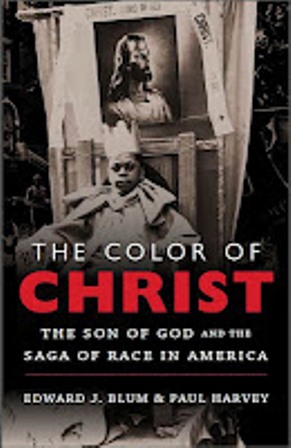
Review of New Book The Color of Christ

A review of my new book (co-authored with Edward J. Blum) in the Publisher’s Weekly, just published (July 9, 2012).

The Color of Christ: The Son of God and the Saga of Race in America
Edward J. Blum and Paul Harvey. Univ. of North Carolina, $32.50 (336p) ISBN 978-0-8078-3572-2

In this powerful and groundbreaking book, historians Blum (Reforging the White Republic) and Harvey (Freedom’s Coming) examine how images of Jesus reflect the intersection of race and religion in America. Blending historical analysis, lucid prose, and captivating primary sources, Blum and Harvey trace the remaking of Jesus from Puritan America to antebellum slave cabins, from Joseph Smith’s revelations to Obama’s presidency. The authors compellingly argue that Christ’s body matters, that it signifies power, reflects national fears and evolving conceptions of whiteness, and perpetuates racial hierarchies by continuously reifying the idea that whiteness is sacred. Blum and Harvey deconstruct the axioms that racial groups simply depict God in their own image, that the white Jesus of America is a mere replication of European art, and that Jesus has been depicted as white since America’s colonization. The authors devote significant time to exploring how marginalized groups, especially African-Americans and Native Americans, have reacted to and reimagined representations of Jesus. They masterfully probe how a sacred icon can be a tool at once of racial oppression and liberation. A must-read for those interested in American religious history, this book will forever change the way you look at images of Jesus. (Sept. 21)
Posted in Uncategorized | Leave a comment

Review of The Columbia Guide to Religion in American History

The religious historian Matt Sutton has reviewed The Columbia Guide to Religion in American History, for the Christian Century. You can read the review here. A little excerpt:

There are probably few reference books that vacationers will drag down to the beach this summer. And though I make a living in academia, there aren’t many works of reference that I want to read from cover to cover. I love history because I love stories, storytelling and engrossing narratives- not because I’m taken with the facts, figures and dates that populate reference books. But once I agreed to review The Columbia Guide to Religion in American History I had no choice but to crack the spine. I am glad I did.

The guide, edited by Paul Harvey and Edward J. Blum- the former a highly respected and accomplished historian of American religion, the latter one of the rising stars in the profession-provides an excellent overview of many of the most important trends, topics and issues in American religious history.

Read more: http://www.readperiodicals.com/201205/2667177581.html#b#ixzz1wCpdrm99

Posted in Uncategorized | Leave a comment

Youtube Interview on Moses, Jesus, and the Trickster

Here’s a Youtube interview done with me about my book Moses, Jesus, and the Trickster in the Evangelical South (University of Georgia Press,2012).


Posted in Uncategorized | Leave a comment

Faces and Places of Christ: An Introduction

My co-author Ed Blum’s introduction to 8-part blog series “Faces and Places of Christ,” to feature posts by artists, scholars, and writers, starting today and through next Sunday. This is in part a tribute to those who influenced us in writing The Color of Christ. A little excerpt:

 So with Easter season upon us and the importance of “looks” all around us, I decided to contact some of the scholars and artists who influenced the making of our book. These are people who have grappled with the image of Christ in their own lives and works, and who taught Paul and me so much. The guiding questions to them were: “how do visual images of Jesus and where they are placed address religious, social, political, and theological questions? What is your first memory of encountering Jesus in visual form and how do you make meaning of that event now? What does the process of Jesus image making mean in the contemporary world and how does it continue to impact people?”

Each day from tomorrow to Easter, we will feature a different scholar or artist. David Morgan will reflect on his long relationship with the art of Warner Sallman, while Anthony Pinn will call for us to stop looking at Christ and start looking at ourselves. Janet McKenzie will discuss why she painted her now-famous Jesus of the People (1999), while Chad Hawkins will relate how his drawings of The Church of Jesus Christ of Latter-Day Saints temples tries to reflect the timelessness of Christ that calls out to him for humility. We will sit with Arlene M. Sánchez-Walsh as she visits her great-grandmother’s home and sees her Jesús, and we’ll fly back in time to Gary Vikan’s days as a boy scout from Minnesota and the variety of Jesus figures he encountered.

Posted in Uncategorized | Leave a comment

My Friend, the Bancroft Prize Winner

(Crossposted from Religion in American History):

My Friend, the Bancroft Prize Winner

Every once in a while a good and generous person gets their just reward in this life. I’m happy to recognize such a gift today, with the announcement of this year Bancroft Prize winners.

There are three, but I want to highlight one: Anne Hyde’s Empires, Nations, and Families: A History of the North American West, 1800-1860 (University of Nebraska Press).

From today’s New York Times:

The Bancroft Prize, one of the most prestigious annual honors for historians, has been awarded to three scholars for books published last year.

The winners are Anne F. Hyde for “Empires, Nations and Families: A History of the North American West, 1800-1860” (University of Nebraska Press); Daniel T. Rodgers for “Age of Fracture,” an intellectual history of 1970s and 80s America (Belknap Press/Harvard University Press); and Tomiko Brown-Nagin for “Courage to Dissent: Atlanta and the Long History of the Civil Rights Movement” (Oxford University Press).

blogged last year about Empires, Nations, and Families, just as it was coming out, and recommended it to all; a good description of the book and of Anne’s career is here. Since then, it has not gotten nearly as much attention as the other two (very deserving, obviously) recipients, but I bet it will now. There’s something for everyone in the work, including for you religious history scholars, including a major effort to place Mormonism and Indian religions in the broader context/history of “the West” during this period, as it moved from “nations” to “nation,” as well as stories about the intermingling of families which thereby became the intermingling of religious traditions.

The author, Anne Hyde, has been my friend since my first week of graduate school, just a few (28, to be precise) years ago now (she started two years ahead of me at Berkeley, but finished four years ahead of me, a testament to her discipline and my interest in being a jazz hound more than a scholar). We both moved to Colorado Springs close to the same time — myself to take a temporary position at Colorado College, where I filled in for a retired professor until the new permanent replacement came on board — which just happened to be Anne. A few years later I chanced, by the vagaries of the job market, to arrive back in COS to take my position at the little state university on the bluffs overlooking the city, but continued to haunt the Colorado College library as my hideaway for research and writing.

Over the last few years, I sat up on the third floor of the CC library, hacking away at my much shorter and less ambitious books, in a state of constant nervous exhaustion and sartorial disarray, and anxious for 11:45 a.m. to arrive so I could sprint across campus to my NBA (Noon Ball Association) basketball game. Meanwhile, Anne sat a few tables away,  as gracious and evidently serene and composed as ever as she put the finishing touches on a book I assumed would be a very good one, but turns out to be that and more: a 500+ page work that masterfully juxtaposes and weaves together the social, economic, cultural, religious, and political histories of Anglo-American, Native American, Mexican, and other peoples in the trans-Mississippi West from 1800 to 1860. Last summer I sat camped at my 3rd floor library perch and spotted Anne coming to my table with her book, which I knew was just coming out then. She handed me a signed copy; I began reading and was immediately humbled by what an amazing work she had accomplished. I’m thrilled for my friend and colleague and recommend this work to all.

Posted in Uncategorized | Leave a comment

Barack v. the Bible, says Barton: My Latest at Religion Dispatches

Paul Harvey

Some of you who find me here may be interested in following my short essay pieces for the onlinReturn to Religion Dispatches Homee journal Religion Dispatches. The most recent one concerns David Barton, a self-styled historian and one-man intellectual entrepreneur from Texas, who recently declared that Barack Obama is America’s all-time most “biblically-hostile President.” The piece, a classic of bad history writing (I plan to use it in future classes to demonstrate the kinds of fallacies that historians should avoid) , is perhaps more importantly placed within the context of a history of hyperbolic rhetoric about the religiosity (or lack thereof) of American presidents. My essay “It’s Barack v. the Bible, Says Barton,” tries to set the current furor over a supposed “war on religion” in historical context. News flash: we have plenty of arguments about religion and politics all through American history, including now, but there is no “war on religion” going on. Indeed, as the excellent historian John Fea has recently explained, Obama may be the most explicitly Christian president in American history (even as he criticizes the administration’s lack of follow through in certain areas of faith-based initiatives).

Here are my other contributions to Religion Dispatches thus far; click on the link to read any of them. The topics range from pieces on the band Arcade Fire and the singer/performer Gillian Welch, to the superstar Christian financial advisor Dave Ramsey, to a review of the PBS series God in America, to the meaning of the 10th anniversary of 9/11. While you’re at it, my blog Religion in American History is going on 5 years old now, and I’ve got a roster of about 25 top scholars from across the country who contribute there, so make sure to check it out.

It’s Barack v. the Bible, Says Barton
Keeping the “Southern” in Southern Baptist Convention
Martin Luther King in the Era of Occupy
Why 9/11 Changed Everything Nothing
Fix the Economy GOD’$ WAY: Dave Ramsey’s Great Christian Recovery
Blessed With a Dark Turn of Mind: Gillian Welch’s Spiritual Strivings
Selling the Idea of a Christian Nation: David Barton’s Alternate Intellectual Universe
Arcade Fire and the Suburban Soul
Martin Luther King: Libertarian and Anti-Abortion Social Conservative
Congress Reads the Constitution, Tea Party-Style
“Liberal Nazis”: The Republican Crusade Against NPR
Country Music Minus the Culture Wars: A Lesson from a Legend
The Brutality of the American Eden
White Rockers in Search of Soul Salvation

Posted in Uncategorized | Leave a comment

Call Me Any Time

If you are checking out this site, I hope you will follow me elsewhere:

Follow me on Twitter
“Like” my co-authored book The Color of Christ here
Follow podcasts on my books here
Read my group blog Religion in American History, which “directs the scholarly conversation” in the field
Read our blog from the History Department at the University of Colorado
More about me at my faculty website
Check out my Amazon book page 

And thanks for your support

Posted in Uncategorized | Leave a comment