Willie Maude Harvey (1925-2026)

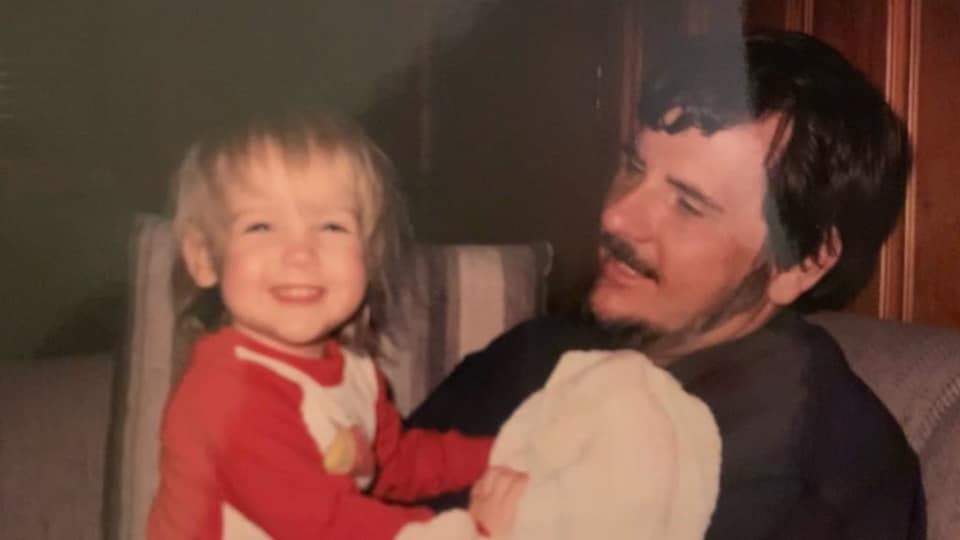
My mother passed away this morning, at the age of 100, coming pretty close to making it to 101. It was no surprise, as she was in decline for a few months. I was asked to prepare an obituary. Newspaper obituaries are typically 300 or so words, and I have one that long for official publication. But I wanted to write something longer, because how can you sum up such an amazing life of 100 years in so few words. So below is the slightly longer version, still too few words but at least with a few more personal details.

Willie Maude Harvey (1925 – 2026)

Willie Maude Harvey (born Willie Maude Weeks) was born in Durant Oklahoma on May 29, 1925. She celebrated her one hundredth birthday happily with family and friends present in Oklahoma City in May 2025. She passed peacefully at 3:00 a.m. on February 27, 2026. She leaves behind four loving children, seven grandchildren, and seven great grandchildren, who currently live in Oklahoma, Texas, Colorado, Washington state, Japan, and the Maldives. All of us join in celebrating her amazing life.

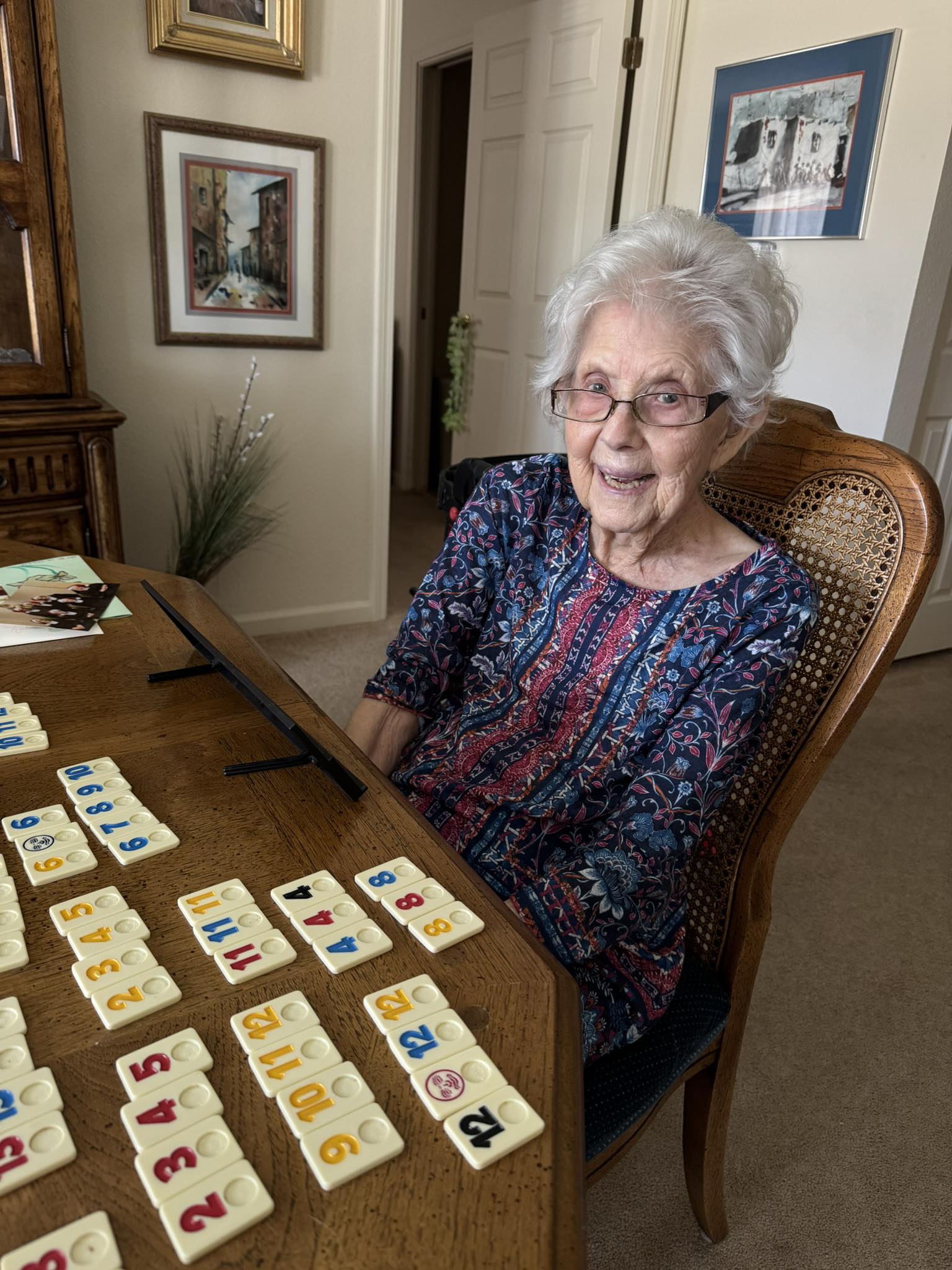
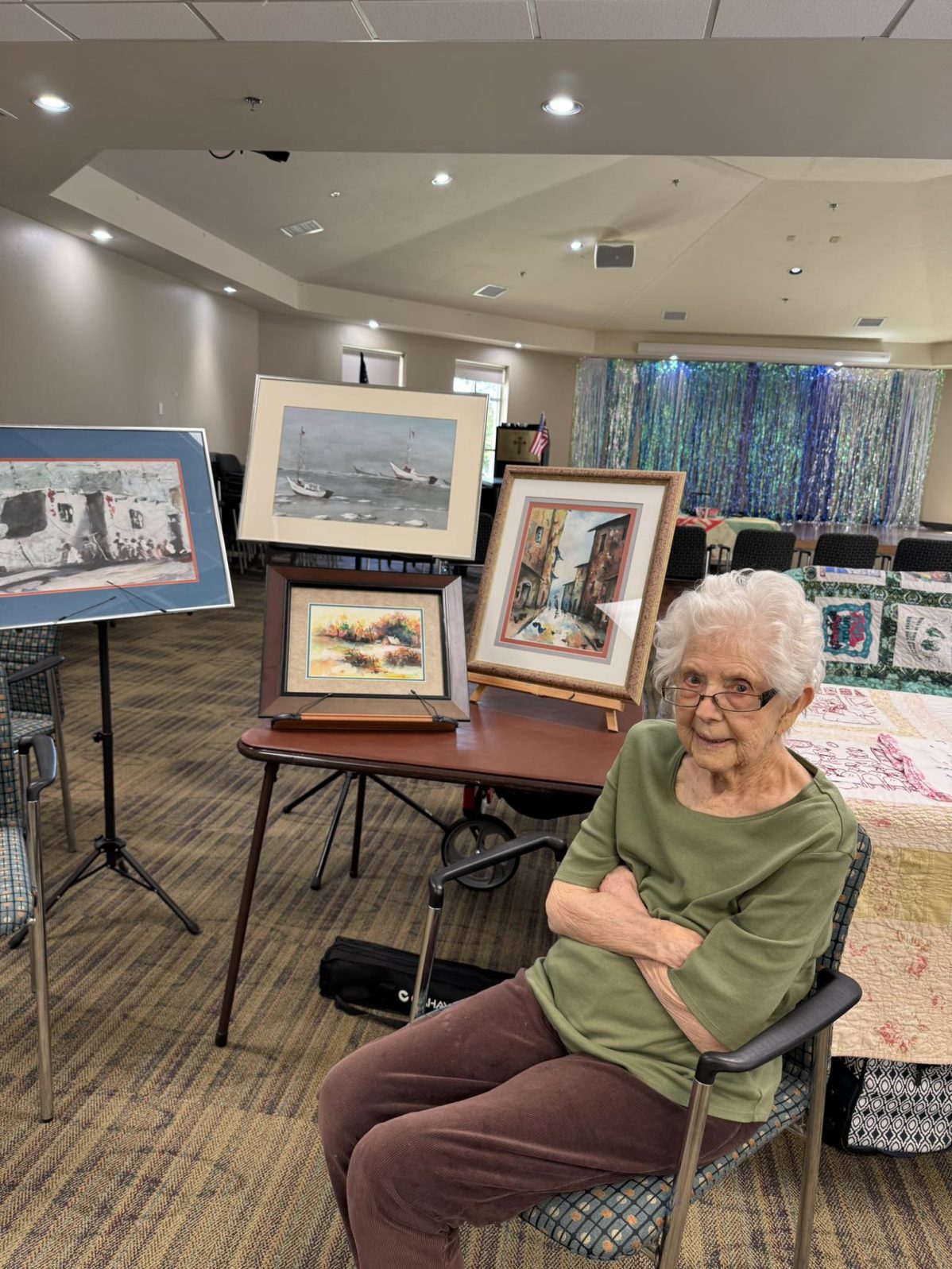
Willie Maude was born in the age of the Model T. She still possessed a sharp mind and wit into the age of Artificial Intelligence. It was one sharp enough to very recently run the table at a game of Rummikub against one hopelessly outmatched son (me); even at age 100 she still laid down the square tiles like a champ. For much of her adult life, that mind and a creative spark evidenced itself in her luminous art pieces, dozens of which are in the hands now of her children and grandchildren, as well as remarkable quilts. She was particularly proud of her water colors. They are numerous and varied: small studies of flowers, impressionist portraits of New Mexico or Oklahoma landscapes, seaside scenes or sailing ships, street vendors hawking their wares, and much more.

She thought less personally of her oils, but in fact they are just as striking; some of them hung in the home in which her children spent most of their growing up years, a house inventively placed in a sloped landscape at the edge of the town of Beaver, Oklahoma, with a routine view of spectacular Oklahoma sunsets through much of the year visible just by stepping out to the patio. Next door was a house designed by the renowned Oklahoma architect Bruce Goff; we had no idea at the time of its origin, but we certainly knew it was weird and cool. Parked outside was a never-ending array of automobiles, mostly Fords, often handed down to us as we came of age. I was gifted the famous exploding 1973 Ford Pinto, about which the less said the better. Those cars took us on endless trips to and from Liberal (KS), Pampa (TX), Guymon (OK), and further afield to Oklahoma City and Shawnee (over and over again), and occasionally even to Dallas, Houston and at least once (maybe more than that) to California.

Willie Maude was the daughter of a Baptist preacher. She possessed a Christian faith that carried her through a Depression-era childhood in small town Oklahoma and bouts of diphtheria and other diseases (and tragic losses of siblings) characteristic of the era; through cross-country train and bus trips during World War II, as her parents moved to California for defense industry work but she returned to Oklahoma for college at Oklahoma Baptist University, where she majored in biology and in 1946 tutored in German a recently returned Navy veteran named William (Bill) Gipson Harvey (1925-2008), whom she married in 1949; through his career in medical school in Oklahoma City while she worked as a secretary; through her years of raising four children in various small towns in Oklahoma, finally settling in Beaver in 1961, where she lived until moving to Oklahoma City in 1987; through breast cancer in the 1970s, and numerous nagging health problems that followed her afterwards; through long lonely days at home as Bill worked endless hours in his family practice clinic; and later through the vicissitudes of later life: graduations and grandchildren, but also hip fractures, dental health tortures, and assorted difficult health issues, and most of all Bill’s unexpectedly sudden death from esophageal cancer in 2008.

Through it all, she retained a spirit that somehow found the best in any situation, a kind word to say about almost anyone (perhaps a few recent blowhard politicians excepted), a word of advice that nearly always turned out to be right even if one didn’t realize it at the time (me, again), a funny witticism or malapropism to relate to lighten the day, or a lightly given but well-placed criticism when one was needed. She loved her family and she cared for other people, and always found some way to show that, more through actions than through words. Like most in our family, she was not much of a talker and not often overtly expressive, but one always knew the care and love that came from her soul.

She studied the Bible through her life (although she admitted to finding some parts of the Old Testament a tad boring); sang or hummed hymns both in congregations and in choirs, not to mention in cars on the way home from church or in the kitchen while making roast beef and mashed potatoes; laughed at Archie Bunker and with Mary Tyler Moore along with everyone else in the 1970s; loved Billy Graham but cast a properly skeptical eye at fraudulent or pompous televangelists who she knew defrauded the faith; read voraciously but wished that she could write as well as Jane Austen; loved musicals and light comedies; learned to play golf (well, sort of — her coach urged her to try to strike the ball rather than dig up weeds with the driver in in the course, as she laughingly related) in an attempt to strengthen her upper body after breast cancer surgery; walked at a rapid pace befitting the energies that kept her alive and mentally alert for such a long life; traveled the world as an adult and constantly tried to plot family cruises for everyone else; cheered loudly for the Oklahoma Sooners and more recently for the OKC Thunder; lit up like a candle at the sight of new grandchildren or great grandchildren; and wanted everybody to be kind and love everybody, and was disappointed when that was not so in our broken world.

Her remains will rest next to Bill Harvey’s in Oklahoma City, but she would be quick to add that her soul will join his in eternity.

Posted in Uncategorized | Tagged , , , , | 1 Comment

Living Together: UCCS Interdisciplinary Project funded by the Henry Luce Foundation

I am pleased to announce the birth of a new Center at UCCS; The Center for the Study of Evangelicalism, the only such Center at a public university campus. The new Center is part of a new Henry Luce Foundation-grant funded project entitled “Living Together: Finding Democratic Diversity and Religious Co-Existence in Colorado Springs.” Go HERE to learn about the project, the grant, and upcoming plans for the Center’s role at UCCS and in Colorado Springs. Very happy to be a principal investigator for this grant along with my colleagues Jeffrey Scholes from the Philosophy Department and George Bayuga from the Anthropology Department. Our first event for the year features the author and commentator Tim Alberta, author of the book The Kingdom, the Power, and the Glory, coming to speak at UCCS at the Ent Center on October 2nd. Click HERE to get your ticket (it’s free, but attendees will need a ticket for entrance). Much more news to come on this soon!

Posted in Uncategorized | Leave a comment

Special Episode Released Today
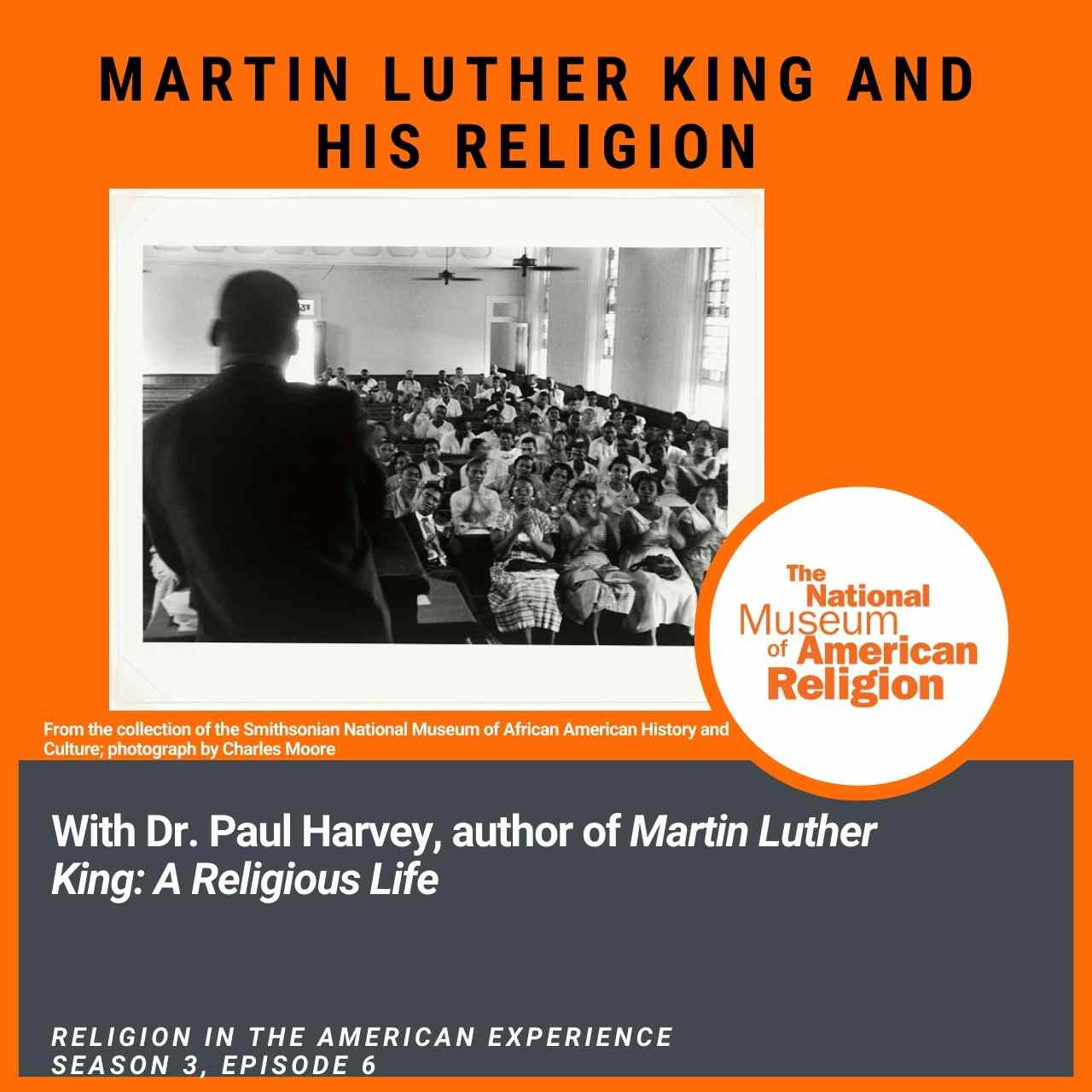
Martin Luther King is a larger-than-life character in the American narrative, playing a pivotal role in the nation’s mid-twentieth-century Civil Rights Movement. His “I Have a Dream” speech at the Lincoln Memorial in Washington, DC in August of 1963 as part of the March on Washington for Jobs and Freedom is an integral part of Americans’ understanding of him and the Civil Rights Movement. However, talking about receiving the Nobel Peace Prize in 1964 he said, “I am a minister of the gospel, not a political leader”, suggesting there is more, much more, to him than “I have a dream.” This podcast episode is going to explore the religion of Martin Luther King, what it was, how it formed him, inspired him, burdened him, and animated him.
On this episode, we interview Paul Harvey, Distinguished Professor History and Presidential Teaching Scholar at University of Colorado at Colorado Springs. He researches, writes, and teaches in the field of American history from the 16th century to the present. Paul is the author of “Martin Luther King: A Religious Life”, “Howard Thurman and the Disinherited: A Religious Biography”, “Christianity and Race in the American South: A History”, and “Bounds of Their Habitation: Religion and Race in American History”. He received his Ph.D. from the University of California, Berkeley. Available on Apple Podcast or Spotify.
Posted in Uncategorized | Leave a comment

Martin Luther King: A Religious Life

A great review of my brand new book Martin Luther King: A Religious Life, just published (1 November 2021) by Rowman & Littlefield. This is from Publisher’s Weekly.

 Martin Luther King: A Religious Life

Martin Luther King: A Religious Life
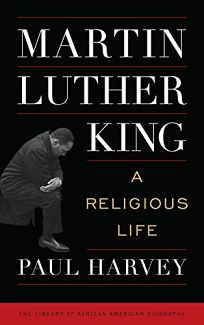
Historian and professor Harvey (The Color of Christ) plumbs the background and writings of Martin Luther King Jr. to provocatively build a religious frame around the civil rights leader’s beliefs and tactics. Delving into the formative intellectual and theological influences on King’s writings and activities, Harvey’s approach is not primarily as a biographer but rather a close reader of the evolution of King’s thought; as Harvey notes, “King’s radicalism had deep roots. The black religious tradition informed him through its history of protest and proclamation.” King’s ways of thinking are considered across his accomplishments and failures in civil rights campaigns including in Montgomery, Selma, and Chicago. Throughout, Harvey stresses King’s unwavering commitment to nonviolence; his political realism, derived in part from his study of Reinhold Niebuhr; and his fundamental economic radicalism. (King first read Karl Marx in 1949 while in seminary.) Harvey also acknowledges King’s “anxiety reduction” practices of drinking and sexual dalliance (which the FBI surveilled obsessively). Importantly, Harvey takes on in an epilogue the “distortions” (or “symbolism [over] substance”) of King’s message in the decades following his 1968 assassination. This careful and of-the-moment examination of King’s fundamentally religious worldview should take a prominent place on the shelf of literature about the man who changed 20th century America. (Nov.)DETAILS

Posted in Uncategorized | Leave a comment

My Professor and My Brother-in-Law: An Appreciation

My Professor and My Brother-in-Law:
A Dual Eulogy and Appreciation.

Within the course of 24 hours recently, I learned of two significant deaths, each of which affected me greatly emotionally, but also left me with gratitude for their presence in my life. And they made me think about what unites people across seemingly large divides.  

First, my graduate school mentor, Leon Litwack, passed away at the age of 91, at his home in Berkeley, California. He was surrounded by his beloved books, soon to be part of the storied Bancroft library at the University of California, Berkeley (he had said shortly before that he wished he could take them with him), and Rhoda, his wife since 1952. Leon taught history at UC Berkeley from 1964 to 2010, and changed the course of scholarship in American history through his teaching and publishing. The email informing a group of us of his passing mentioned that towards the end he no longer listened to music – a sure sign that he was ready to go. He loved to quote a line from Robert Palmer’s book Deep Blues: “How much history can be communicated by pressure on a guitar string?”; and once, driving me to some place in Berkeley in the mid-1980s, he told me and another person with us that day of his recently discovered love for country music, to go along with his equal passions for blues, rap, Beethoven, Mahler, Robert Johnson, Muddy Waters, Creedence Clearwater Revival (whom he knew as young aspiring Bay Area rock musicians), and the early U2. For him, once there was no music, there was no life to be had.

The following day, my brother called me to let me know of the passing of our brother-in-law, Carroll McNish, who was 80 years old. He was husband for many years to our older sister Gayle, and was a beloved member of our family. As his daughter put it, “he was my number one fan, and everyone he ever met’s number one fan.” He passed at home in Yukon, Oklahoma, (I know this from Gayle) surrounded by immediate family and two irrepressible border collies and his amazing collection of model cars and memorabilia. His service was just held in Oklahoma City, and the affection of all for Carroll was abundantly evident.

Leon Litwack was a renowned American historian, known all over the world for his books and lecturing; Carroll McNish was by trade a professional and master car mechanic and instructor at a Vo-Tech school, a community college in Oklahoma City, and a General Motors Training School for many years, alongside many other jobs that he held. He was also a person who seemed to be able to fix anything, a rare quality among the men of our family, who generally are hopeless at such things. Well, me, at least.

Leon grew up in Santa Barbara, California, the son of Jewish immigrants, sailed the world as a young man working on ocean liners, and had a lifelong intellectual fascination with the American South and with American folk culture (I often heard him and a few of his colleagues fill out the roster of their fantasy Jewish all-time all-star baseball team, with Sandy Koufax starting on the mound); Carroll grew up in Del City, Oklahoma, and was a fan of automobiles, stock car racing, recreational vehicles, puttering about in the garage, driving my sister to agility trial competitions for her border collies, the Oklahoma State Cowboys, the Oklahoma City Thunder, country music, and, most recently and delightfully strangely, cross-fit competitions.

Carroll’s stories and speech came from the stuff of everyday life. He had a tone of voice in speaking (albeit pitched at a baritone rather than a tenor level) that reminded me of the singer and fellow Oklahoman Vince Gill. Carroll was exactly the kind of person that Leon loved to talk with, in part to understand an American history that he felt had been denied him in his younger years, when “history” consisted of learning about Great Men and their Great Deeds. His career was about rewriting American history with people (good, evil, indifferent, brilliant, humanitarian, sociopathic — whatever their condition was) at the center. And, I suspect, they shared a mutual disdain for various kinds of political hypocrisies.

I know for sure they shared a mutual disgust for laziness and incompetence in their chosen fields of endeavor; ” deadwood” was Leon’s damning epithet for non-productive faculty members who neither published much or taught with the fierce passion that he did, and Carroll had any number of words, printable and otherwise, for people who didn’t know what they were doing but charged you for doing it anyway — the deadwood in his chosen fields of endeavor.

Both were men who radiated humanity, kindness, a well-earned pride in their competence in their work, a sly wit tinged with just a touch of ironic observation of human foibles, and a profound caring for other people, expressed most of the time more through actions than through words. And both were also devoted to their respective crafts; towards the end of his teaching career Leon suffered a stroke while lecturing and insisted on finishing his course that day, much to the horror of his teaching assistants, while Carroll, much to my own father’s warm approbation, was working on something or other, a car repair if I remember correctly, the morning of his marriage to my sister. “That’s a man after my own heart,” my father, a fellow devotee of work and family and caring for others, said of him around that time. Later in his life, Carroll took up a job as a testing proctor for some testing company (the kind that administers the ACTs and SATs and those sorts of standardized exams); Leon, meanwhile, continued teaching after his stroke, still mentally sharp as ever but now with a gravelly voice, his vocal cords never fully able to recover from the damage they had suffered in the stroke. But giving up his teaching post was hard, as he loved teaching and took justifiable pride in his reputation as a master of that craft. Likewise for Carroll, giving up a work routine was difficult, and so he continued working even when he didn’t have to, and despite the pain he suffered from a previous bout with pancreatic cancer and other assorted ills that ravaged him late in his life.

One essential thing that united the two was a love for teaching what they knew well, and a love for students. “Carroll loved teaching, the automotive industry, and especially loved his students,” the program for his funeral says; for Leon, simply substitute the history profession for the automotive industry, and you have the same thing.

I like to imagine what sort of conversation Leon and Carroll would have had, if they had ever met. Perhaps it would have started awkwardly, as both had some innate shyness and liked to repeat stories as a way of making conversation. But once Carroll would have started talking, Leon would have taken an immediate shine to him. Leon had an ear for authentic voices, and he loved listening to the stories of people talking about their lives. It was his great contribution to American history to bring those kind of people to the front and center of history, not because he romanticized them, but because he saw them as what history, ultimately, was all about. It was his calling, he thought, to bring them to the center of history, where they belonged.

Carroll’s soft Oklahoma accent and intonations would have appealed to him, and I can see Leon, clicking into oral historian mode, begin to ask him questions about what Carroll’s life had been like while younger, how he might have experienced the 1960s (everyone knows about Berkeley, but what was happening in Oklahoma City?); and what he had done as a Vo-Tech instructor, and what his favorite makes and years of cars were, and who his favorite country musicians were, and where might be the best barbecue or fried chicken place that he knew of in Oklahoma City.

And Carroll, once he got going on something, enjoyed talking and explaining how a certain piece of machinery worked, or why the cars lined up as they did as they rounded the curve on a race track, or why a certain kind of ethanol mix required in cars meant that the cars didn’t run as well, or why a particular home appliance broke down at the exact moment you needed it — or, most importantly, what his daughter Layne, my niece, had been up to lately (crossfit, it turns out).

Leon loved human speech of that sort, often quoted from it in his lectures, and struck up friendships with people from all walks of life in part because he loved to hear them tell their stories of everyday life that became part of his understanding of American history. His books are full of those stories, woven into masterful narrative interpretations of American social history.

In a way, the two had nothing in common; in another way, they had everything in common, each unerringly kind and supportive of those around them in their own ways, and both a master at communicating what they cared about, what they worked on diligently for many years, and what they wanted us to know about what was really important in life.

Posted in Uncategorized | 5 Comments

Howard Thurman

thurmancoverI’m happy to announce the publication of Howard Thurman and the Disinherited: A Religious Biography, with Eerdmans’s Press. This is the first modern biography of this absolutely central figure in American religious, racial, and intellectual history, one whose theology and writings provided a direct link to African American traditions of nonviolent resistance.
A small portion of this book was published as “Howard Thurman and the Arc of History in San Francisco,” a couple of years ago, and as Howard Thurman Inspired Martin Luther King’s Philosophy. A review of this book, just prior to publication, can be found here. 

Posted in Uncategorized | 1 Comment

Recent Interviews and Podcasts

9781442236189In late 2016, I published two new books: 9780226415352
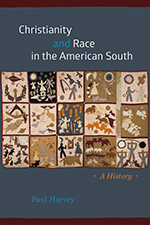
**Christianity and Race in the American South: A History

**Bounds of Their Habitation: Race and Religion in American History

Below is a list of recent interviews, podcasts, and lectures based on work from these two books.

The Research on Religion podcast features an interview/podcast focusing on my book Christianity and Race in the American South: A History. The interview is sponsored by the Baylor Institute for for Studies of Religion.

The New Books Network podcast features an interview/podcast focusing on my book Bounds of Their Habitation. The interview is conducted by noted scholar Lilian Calles Barger.

Noted historian Thomas Kidd conducts an interview with me about the book Bounds of Their Habitation here, for the blog The Gospel Coalition.

John Fea’s regular feature “The Author’s Corner” focuses on my book Bounds of Their Habitation.

Noted Yale historian Tisa Wenger reviews Bounds of Their Habitation at the Reading Religion page sponsored by the American Academy of Religion.

A piece discussing my two book published in November 2016 appears here at the Religion in American History blog.

My 2015 lecture at Baylor University, “The Battle for Jesus During the Civil War,” is available here as a video. An article in the Baylor paper discusses the talk.

Posted in Uncategorized | Leave a comment

The Color of Christ Meets a Cast of Critiques

jesusguitarRecently at my blog Religion in American History, three outstanding scholars published the critiques they delivered of The Color of Christ at the 2013 American Academy of Religion meeting in Baltimore; and at the end of those, co-author Edward J. Blum and I responded. Click here to go first to our response, and then follow the days backward or click below on the links provided for the individual responses.

Response from Kathryn Gin Lum (Stanford University)
Response from Josh Paddison (Wittenberg University)
Response from Jennifer Graber (University Texas)

Posted in Uncategorized | Leave a comment

Color of Christ Named Top 25 Outstanding Academic Title

Professor’s book named outstanding academic title

 by , reprinted from UCCS CommuniqueColor of Christ

Subject editors of Choice: Current Reviews for Academic Libraries recently announced The Color of Christ: The Son of God & the Saga of Race in America as one of the Top 25 Books in its annual Outstanding Academic Titles List.

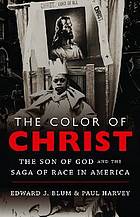
The Color of Christ was written by Paul Harvey, professor, Department of History, and Edward Blum, associate professor, Department of History, San Diego State University. The book explores the nature of Christ worship in the U.S. and addresses how his image has been visually remade to champion causes of white supremacists and civil rights leaders alike, and why the idea of a white Christ has endured.

Choice is a leading source for reviews of academic books, electronic media, and Internet resources of interest to those in higher education. More than 22,000 librarians, faculty, and key decision makers rely on Choice magazine and Choice Reviews Online for collection development and scholarly research.

In a Dec. 16 release, Choice shared the “Top 25 Books: and “Top 10 Internet Resources” lists. A full Outstanding Academic Titles list will appear in the Jan. 2014 issue.

Posted in Uncategorized | Leave a comment

The Color of Christ: Discussion Forum at the American Academy of Religion

Hoping to see lots of blog friends, readers, and followers at the American Academy of Religion in Baltimore coming up in less than two weeks, for the special “authors meet critics” session on The Color of Christ, to be held Monday, November 25, 9 – 11:30 a.m., in Convention Center 310. The session is co-sponsored by the North American Religious History Section, and the Afro-American Religious History Group. There is a great lineup of respondents, noted below. Hope to see friends there. For those who can’t make it, there’s a great online forum on the book, published here. 

North American Religions Section and Afro-American Religious History Group

Theme: Authors Meet Critics: The Color of Christ: The Son of God and the Saga of Race in America by Paul Harvey and Edward Blum (University of North Carolina Press, 2012)

Stephen Prothero, Boston University, Presiding
Monday – 9:00 AM-11:30 AM
Convention Center-310

From Protestant rejections of religious iconography to the messianic mythologies of American original religions like Mormonism to the poetry of Langston Hughes to the 2008 election of Barack Obama, Jesus Christ has been a “shape-shifting totem” of religious and racial meanings. Exploring such various verbal and visual representations of Jesus Christ in The Color of Christ: The Son of God and the Saga of Race in America, historians Edward Blum and Paul Harvey tell the story of “the holy face of race in America.” This round table consisting of responses to the book from scholars in various disciplines will evaluate Blum and Harvey’s explanation of “how a land settled, in part, by Puritan iconoclasts from England became one of the most abundant producers and consumers of diverse Jesus imagery.”

Panelists:

Joshua Paddison, Wittenberg University
Kathryn Gin Lum, Stanford University
J. Kameron Carter, Duke University

Responding:
Edward Blum, San Diego State University
Paul W. Harvey, University of Colorado
Jennifer Graber, University of Texas

Posted in Uncategorized | Leave a comment